<body><script type="text/javascript"> function setAttributeOnload(object, attribute, val) { if(window.addEventListener) { window.addEventListener('load', function(){ object[attribute] = val; }, false); } else { window.attachEvent('onload', function(){ object[attribute] = val; }); } } </script> <div id="navbar-iframe-container"></div> <script type="text/javascript" src="https://apis.google.com/js/platform.js"></script> <script type="text/javascript"> gapi.load("gapi.iframes:gapi.iframes.style.bubble", function() { if (gapi.iframes && gapi.iframes.getContext) { gapi.iframes.getContext().openChild({ url: 'https://www.blogger.com/navbar/1042626312146086864?origin\x3dhttp://medreader.blogspot.com', where: document.getElementById("navbar-iframe-container"), id: "navbar-iframe" }); } }); </script>

Blog Team

Archives

July 28, 2007

Health Tip: Causes of Fainting

Fainting occurs due to a sudden drop in blood flow to the brain, resulting in brief loss of consciousness. Fainting can be accompanied by dizziness or nausea.

Here are some common triggers, courtesy of the U.S. National Library of Medicine:

- Straining during urination or a bowel movement.
- Excessive coughing.
- Standing for too long in the same position, or quickly standing up from a lying position.
- Severe pain, stress, fear or emotional distress.
- Excessive bleeding or dehydration.
- Medications used to treat conditions like high blood pressure, anxiety, allergies and nasal congestion.
- Use of drugs or alcohol.
- Low blood sugar.

Sourse - HealthDay News

Labels: , ,

July 20, 2007

Vitamin A Compound Could Fight Rheumatoid Arthritis


Research in mice suggests that a vitamin A derivative, retinoic acid, may fight autoimmune and inflammatory diseases such as colitis or rheumatoid arthritis, U.S. scientists say.

A team at the La Jolla Institute for Allergy & Immunology in California found that manipulating the amount of retinoic acid (a substance derived when vitamin A is broken down in the body) in the mice affected levels of pro-inflammatory T-cells.

These T-cells are a type of white blood cell that plays a role in several inflammatory and autoimmune diseases.

"We found that you can control inflammation in a living animal with retinoic acid or you can treat cells with retinoic acid in a test tube and transfer them to the organism to suppress inflammation," research leader Hilde Cheroutre said in a prepared statement.

The findings were published in the June 14 online issue of Science.

| Tags: Arthritis, Nutrition |

Labels: , ,

July 15, 2007

Pack Health Into Your Summer Holiday


Planning for your summer vacation involves more than looking at brochures, packing, and traveling to your destination. You also need to protect your health, says Dr. Kathy Alvarez, a family medicine physician at Baylor All Saints Medical Center in Forth Worth, Texas.

She offers the following advice for having a healthy vacation:

- Talk to you doctor about where you're going and whether you need any immunizations. This is especially important if you're traveling to other countries, but it's also a good idea for those traveling in their own countries.
- Be sure to bring all important health-related information and medical supplies. "Carry a list of the medications you're taking and any allergies you have, your doctor's name and phone number, and your health insurance information," Alvarez said in a prepared statement. "If you take daily doses of medication, pack a couple of extra days' worth just in case your plans change or your transportation home is delayed."
- Do your best to avoid germs in planes, taxis, when exchanging money, and in other travel-related settings and situations. Washing your hands as often as possible can reduce your risk of getting sick.
- Drink only bottled water, which should also be used to brush your teeth. Don't eat any food that's been washed or cooked in water, unless it's been boiled. Don't drink beverages with ice.
- Don't overeat. "Try to limit splurging to only one meal a day, and share high-fat and high-calorie dishes with a friend," Alvarez said. If possible, avoid buffets.
- Stay active on your holidays by planning outings that involve plenty of walking.

More information
The MedlinePlus Medical Encyclopedia offers more travel health tips.

Sourse - HealthDay News

| Tags: Children's Health, Digestive, Public Health and Safety |

Labels: , , ,

July 9, 2007

Chronic Obstructive Pulmonary Disease in seniors years


Chronic obstructive pulmonary disease (COPD) develops slowly over many years sometimes before you notice symptoms such as “feeling short of breath.” Cigarette smoking is the most common cause of COPD. It can also be caused by breathing in lung irritants like pollutions, dust, or chemicals over a long period of time.

Chronic obstructive pulmonary disease is usually diagnosed in people 40 years old or older, and is a major cause of death and illness throughout the world. In the U.S.A., chronic obstructive pulmonary disease is the 4th leading cause of death. There is no cure for chronic obstructive pulmonary disease. It is not a contagious disease. Damage to airways and lungs cannot be reversed.

There are only things you can do to feel better and slow the damage to your lungs.

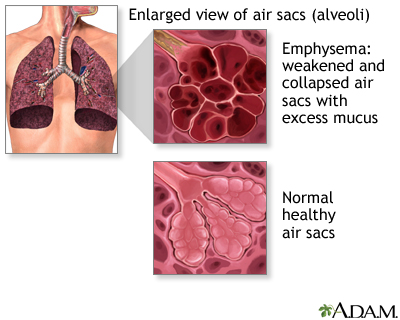
In a healthy person airways of the lungs are clear and open and the air sacs are small, elastic, and springy. In people diagnosed with chronic obstructive pulmonary disease, the airways and air sacs lose their shape and become floppy.

Causes of chronic obstructive pulmonary disease include:

Cigarette smoking (most common cause)
Breathing fumes and other pollutants that irritate and damage the lungs and airways
Pipe, cigar and other types of tobacco smoking can cause COPD especially if the smoke is inhaled.
People with a family history of COPD are more likely to get the disease if they smoke
Secondhand smoke plays a role in causing COPD
Frequent, severe lung infections in childhood may increase the risk for acquiring COPD later in life

Symptoms of chronic obstructive pulmonary disease start years before the flow of air in and out of the lungs is reduced and include:

Cough with sputum production (most common is a cough that does not go away and coughing up lots of sputum)
Shortness of breath especially with exercise
Wheezing or whistling sound when you breathe
Tightness in the chest

It is important to note that not everyone who has a cough and sputum goes on to develop chronic pulmonary obstructive disease.

A doctor looking for chronic pulmonary obstructive disease will examine you, listen to your lungs and ask you questions about your medical history. Physician questions will include what kind of lung irritants you may have been around for long periods of time and if you smoke.

A breathing test called “spirometry” may be used. It is painless and used to show how well your lungs work. Based upon this the spirometry test results, your doctor can determine if you have chronic pulmonary obstructive disease and just how severe it is. There are four levels of chronic pulmonary obstructive disease severity, they are:
People at risk for COPD
People with mild COPD
People with moderate COPD
People with severe COPD

Goals of treatment of chronic obstructive pulmonary disease include:

To relieve symptoms with no or minimal side effects from the treatments
To slow progress of chronic obstructive pulmonary disease
To prevent complications from the disease
To improve overall health

The exact treatment plan for chronic obstructive pulmonary disease can be different for each person and is based on whether symptoms are mild, moderate or severe.

Treatments used for chronic obstructive pulmonary disease include:
Medications such as bronchodilators that work by relaxing the muscles around the airways to open them up and make it easier to breathe. Bronchodilators are inhaled directly into the lungs via an inhaler
Pulmonary or lung rehabilitation
Oxygen treatment
Surgery
Treatments to manage complications or sudden onset of symptoms
Pneumococcal vaccine may be recommended to prevent pneumonia
Annual flu shot to avoid breathing complications from the flu

Surgery is usually done for patients with severe symptoms that do not improve from other types of

treatments, and have a hard time breathing most of the time. The two types of surgery that are considered in cases of severe chronic obstructive pulmonary disease are:
A bullectomy to remove a large air sac that may compress a good lung
A lung transplant

Hospitalization may be needed if:
You have a lot of difficulty catching your breath
You have a hard time talking
Your lips or fingernails turn blue or gray

Source: The American Lung Association

| Tags: Allergy, Flu Health, Lung Cancer, Smoking Cessation |

Labels: , , , ,

July 8, 2007

Simple Blood ?


O-no! The chance of receiving mismatched blood during a medical procedure is estimated to be 1 in 12,000, making it a more common problem than blood shortages.

In 2003 Tawnya Brown was awaiting bowel surgery in a Northern Virginia hospital when she decided to switch beds to be closer to the window. The move ultimately killed her. During surgery, Brown mistakenly received two pints of A-negative blood. She was O-positive. An investigation revealed that a technician had drawn blood from the wrong patient. Within minutes of the procedure, the 31-year-old suffered a fatal hemolytic reaction, which resulted in plunging blood pressure and kidney failure.
Blood mix-ups, though rare, are still one of the most feared mistakes in transfusion medicine. "It's the biggest threat today," says Dr. Kathleen Sazama, a transfusion expert at the University of Texas M.D. Anderson Cancer Center in Houston.

| Tags: Allergy, Cancer |

Labels: ,

July 5, 2007

New "asthma gene" could lead to new therapies


A gene that is strongly associated with a risk of developing childhood onset asthma was identified by an international team of scientists, whose findings are published Wednesday in the journal Nature.

In a genetic study of more than 2,000 children, scientists from the University of Michigan and colleagues from London, France and Germany found genetic markers that dramatically increase a child's risk for asthma.

These markers are located on chromosome 17, and children with this marker had higher levels of a new gene called ORMDL3 in their blood, which occurs in higher amounts in children with asthma. The presence of the disease-associated version of ORMDL3 increases the risk of asthma by 60-70 percent, the study suggests.

"In terms of an asthma gene, there have been quite a few reports but not one that can be clearly reproduced in samples," said Goncalo Abecasis from University of Michigan School of Public Health.
"I think eventually it will lead to new therapies because it points to a specific biological molecular pathway. Once we understand the biology and we know the players, it's possible to target with specific drugs."

Sourse - Xinhua

| Tags: Allergy, Asthma, Children's Health |

Labels: , , ,

May 1, 2007

Cought


A cough is considered chronic if it persists for longer than 3 weeks. In the nonsmoker with a chronic cough who is not taking angiotensin-converting enzyme (ACE) inhibitors and who has a normal chest radiograph, one of three diagnoses is likely: postnasal drip syndrome (PNDS), asthma, or gastroesophageal reflux disease (GERD). Many patients have more than one cause (1,2,3 and 4).


I. Cough due to postnasal drip.

Presentation
Singly or in combination with other conditions, PNDS is the most common cause of all chronic cough. This syndrome is due to a variety of upper airway conditions including the common cold, allergic rhinitis, vasomotor rhinitis, postinfectious rhinitis, rhinitis due to environmental or medication irritants, and acute and/or chronic (bacterial) sinusitis. These various entities overlap and may best be called rhinosinusitis.

Diagnosis
There are no definitive diagnostic criteria for PNDS. A favorable response to therapy is the best way to make the diagnosis. Allergy testing can be helpful in some patients, but positive skin tests do not prove that allergy is the cause. Direct nasolaryngoscopy may also be useful. A four-view sinus radiograph or, preferably, a sinus coronal CT scan will show the presence of chronic sinusitis, provided it is obtained at least 6 weeks after an acute episode to avoid false positives (3).

Management
Empirical therapy for PNDS should be tried before beginning an extensive diagnostic workup. For vasomotor or postinfectious rhinitis, the older generation of antihistamine/decongestants has been shown to be effective (4). To reduce side effects, initiate therapy at bedtime. The newer generation antihistamines, either alone or in combination with pseudoephedrine, have not been shown to reduce cough associated with the common cold. The use of ipratropium or azelastine nasal sprays (2 sprays in each nostril bid) may also be effective. For PNDS due to allergic rhinitis, all oral antihistamines, nasal cromolyn, and nasal steroids are effective. Nasal steroids are the drug of choice and their administration may be necessary for at least 3 months. Antibiotics used to treat chronic sinusitis include amoxicillin (Amoxil) 500 mg tid, trimethoprim–sulfamethoxazole (Septra DS) bid, or erythromycin (Erythromycin Filmtab) 250 mg qid (all for 3 weeks); or azithromycin (Zithromax), two 250-mg tablets on day 1, followed by one tablet daily on days 2–5, with the regimen repeated after 1 week off. (See Chapter 8.5.) Nasal washes may also be helpful.


II. Cough variant asthma. (See also Chapter 10.1.)

Presentation
This entity is easily overlooked because breathlessness or wheezing may be minimal. A viral respiratory illness or a bacterial or atypical bronchitis may initiate this cough variant asthma. This postinfectious type of cough variant asthma is a common clinical occurrence. Seasonal or specific allergies can also precipitate this syndrome. The cough is usually nonproductive and occurs throughout the day and night.


III. Cough due to GERD

Presentation
Many patients with cough have typical gastrointestinal (GI) symptoms, such as sour taste, heartburn, and regurgitation. However, some have no GI complaints, and the reflux is only discovered upon workup (5).

Diagnosis
In patients with typical GI symptoms or those in whom a GI cause is suspected, 24-hour ambulatory esophageal pH monitoring is the best test. But first ask about a time of cought, if it is bedtime, you should think, GERD.

Treatment
The H2 antagonists, such as cimetidine (Tagamet) 800 mg qd or ranitidine (Zantac) 150 mg bid, are the mainstays of drug therapy (4). As some patients' symptoms may not improve for 2–3 months, long-term treatment may be necessary. Interestingly, both cough symptoms and reflux continue to be suppressed for more than 6 weeks after H2 blockers are stopped. Proton pump inhibitors, such as omeprazole (Prilosec) 20 mg qd to 40 mg bid, are also used and may be tried if there is no response to or poor toleration of H2 blockers. It is difficult to predict which patients will respond to therapy. Antireflux surgery, now frequently done by laparoscopy, is reserved for patients with continued symptoms who fail medical therapy, including proton pump inhibitors.

| Tags: Allergy |

Labels: ,