<body><script type="text/javascript"> function setAttributeOnload(object, attribute, val) { if(window.addEventListener) { window.addEventListener('load', function(){ object[attribute] = val; }, false); } else { window.attachEvent('onload', function(){ object[attribute] = val; }); } } </script> <div id="navbar-iframe-container"></div> <script type="text/javascript" src="https://apis.google.com/js/platform.js"></script> <script type="text/javascript"> gapi.load("gapi.iframes:gapi.iframes.style.bubble", function() { if (gapi.iframes && gapi.iframes.getContext) { gapi.iframes.getContext().openChild({ url: 'https://draft.blogger.com/navbar/1042626312146086864?origin\x3dhttp://medreader.blogspot.com', where: document.getElementById("navbar-iframe-container"), id: "navbar-iframe" }); } }); </script>

Blog Team

Archives

July 15, 2007

Mystery disease affects 100 at Bangladesh school


More than 100 students and teachers from a school in Bangladesh have been admitted to hospital after suffering convulsions, police said on Saturday.

The cause of their sudden illness was being investigated.

The victims fell ill at Adiabad School and College near Narshingdi district town, 55 km (34 miles) northeast of the capital Dhaka, a police inspector said.

Twenty-three people died in Bangladesh in 2004 from a mysterious disease later diagnosed as an encephalitis, or inflammation of the brain caused by a viral infection. Dozens more were infected with the disease, which some had feared was bird flu.

Bird flu in Bangladesh since March this year has forced authorities to cull nearly 255,000 chickens and destroy more than 2.2 million eggs.

Authorities said there was no case of human infection.

| Tags: Public Health and Safety |

Labels: ,

July 9, 2007

Six-year-old boy dies of bird flu in Indonesia


A 6-year-old boy died of bird flu at the weekend, bringing the country's death toll from the disease to 81, a health ministry official said on Monday.

| Tags: Flu Health |

Labels:

Chronic Obstructive Pulmonary Disease in seniors years


Chronic obstructive pulmonary disease (COPD) develops slowly over many years sometimes before you notice symptoms such as “feeling short of breath.” Cigarette smoking is the most common cause of COPD. It can also be caused by breathing in lung irritants like pollutions, dust, or chemicals over a long period of time.

Chronic obstructive pulmonary disease is usually diagnosed in people 40 years old or older, and is a major cause of death and illness throughout the world. In the U.S.A., chronic obstructive pulmonary disease is the 4th leading cause of death. There is no cure for chronic obstructive pulmonary disease. It is not a contagious disease. Damage to airways and lungs cannot be reversed.

There are only things you can do to feel better and slow the damage to your lungs.

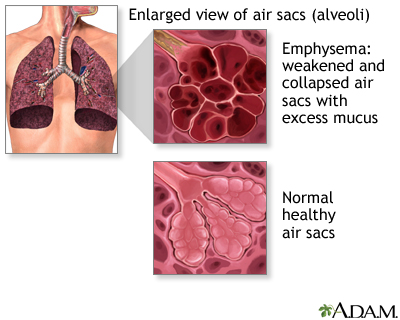
In a healthy person airways of the lungs are clear and open and the air sacs are small, elastic, and springy. In people diagnosed with chronic obstructive pulmonary disease, the airways and air sacs lose their shape and become floppy.

Causes of chronic obstructive pulmonary disease include:

Cigarette smoking (most common cause)
Breathing fumes and other pollutants that irritate and damage the lungs and airways
Pipe, cigar and other types of tobacco smoking can cause COPD especially if the smoke is inhaled.
People with a family history of COPD are more likely to get the disease if they smoke
Secondhand smoke plays a role in causing COPD
Frequent, severe lung infections in childhood may increase the risk for acquiring COPD later in life

Symptoms of chronic obstructive pulmonary disease start years before the flow of air in and out of the lungs is reduced and include:

Cough with sputum production (most common is a cough that does not go away and coughing up lots of sputum)
Shortness of breath especially with exercise
Wheezing or whistling sound when you breathe
Tightness in the chest

It is important to note that not everyone who has a cough and sputum goes on to develop chronic pulmonary obstructive disease.

A doctor looking for chronic pulmonary obstructive disease will examine you, listen to your lungs and ask you questions about your medical history. Physician questions will include what kind of lung irritants you may have been around for long periods of time and if you smoke.

A breathing test called “spirometry” may be used. It is painless and used to show how well your lungs work. Based upon this the spirometry test results, your doctor can determine if you have chronic pulmonary obstructive disease and just how severe it is. There are four levels of chronic pulmonary obstructive disease severity, they are:
People at risk for COPD
People with mild COPD
People with moderate COPD
People with severe COPD

Goals of treatment of chronic obstructive pulmonary disease include:

To relieve symptoms with no or minimal side effects from the treatments
To slow progress of chronic obstructive pulmonary disease
To prevent complications from the disease
To improve overall health

The exact treatment plan for chronic obstructive pulmonary disease can be different for each person and is based on whether symptoms are mild, moderate or severe.

Treatments used for chronic obstructive pulmonary disease include:
Medications such as bronchodilators that work by relaxing the muscles around the airways to open them up and make it easier to breathe. Bronchodilators are inhaled directly into the lungs via an inhaler
Pulmonary or lung rehabilitation
Oxygen treatment
Surgery
Treatments to manage complications or sudden onset of symptoms
Pneumococcal vaccine may be recommended to prevent pneumonia
Annual flu shot to avoid breathing complications from the flu

Surgery is usually done for patients with severe symptoms that do not improve from other types of

treatments, and have a hard time breathing most of the time. The two types of surgery that are considered in cases of severe chronic obstructive pulmonary disease are:
A bullectomy to remove a large air sac that may compress a good lung
A lung transplant

Hospitalization may be needed if:
You have a lot of difficulty catching your breath
You have a hard time talking
Your lips or fingernails turn blue or gray

Source: The American Lung Association

| Tags: Allergy, Flu Health, Lung Cancer, Smoking Cessation |

Labels: , , , ,

July 5, 2007

French swans test positive for bird flu


Three swans found dead in a pond in eastern France have tested positive for the H5N1 strain of bird flu, the Agriculture Ministry said Thursday.

Officials have set up a control zone of about half a mile around the pond in Assenoncourt in the Moselle region to watch for more possible deaths of wild birds, the ministry said.The ministry ordered domestic fowl protected from wild birds and banned pigeon racing competitions and some other activities involving birds.On Tuesday, German authorities said a wild bird in eastern Germany tested positive for the disease. Last month, several wild birds in neighboring Bavaria and Saxony also tested positive.

Bird flu is believed to spread along bird migration routes, and the H5N1 strain has been found in poultry farms in three other EU countries this year: Hungary, Britain and the Czech Republic, the European Commission has said.

France experienced a bird flu scare after an outbreak of the lethal disease in February 2006 in the eastern Ain region. It was quickly contained with authorities slaughtering survivors among the 11,000 turkeys and quarantining farms. A vaccination campaign of fowl was launched. However, dozens of countries briefly suspended imports of fowl and luxury items like foie gras from France.

The H5N1 virus has killed at least 191 people worldwide, according to the WHO.
It remains hard for humans to catch, but experts fear it could mutate into a form that spreads easily among people, potentially sparking a global pandemic. So far, most human cases have been traced to contact with infected birds.

Sourse - Associated Press

| Tags: Flu Health |

Labels: